
How to Write a Message That Opens Like a Gift, Step by Step
A step by step way to write a message that unfolds like a gift being opened: a first line that gives nothing away, a turn, the reveal, and a close.
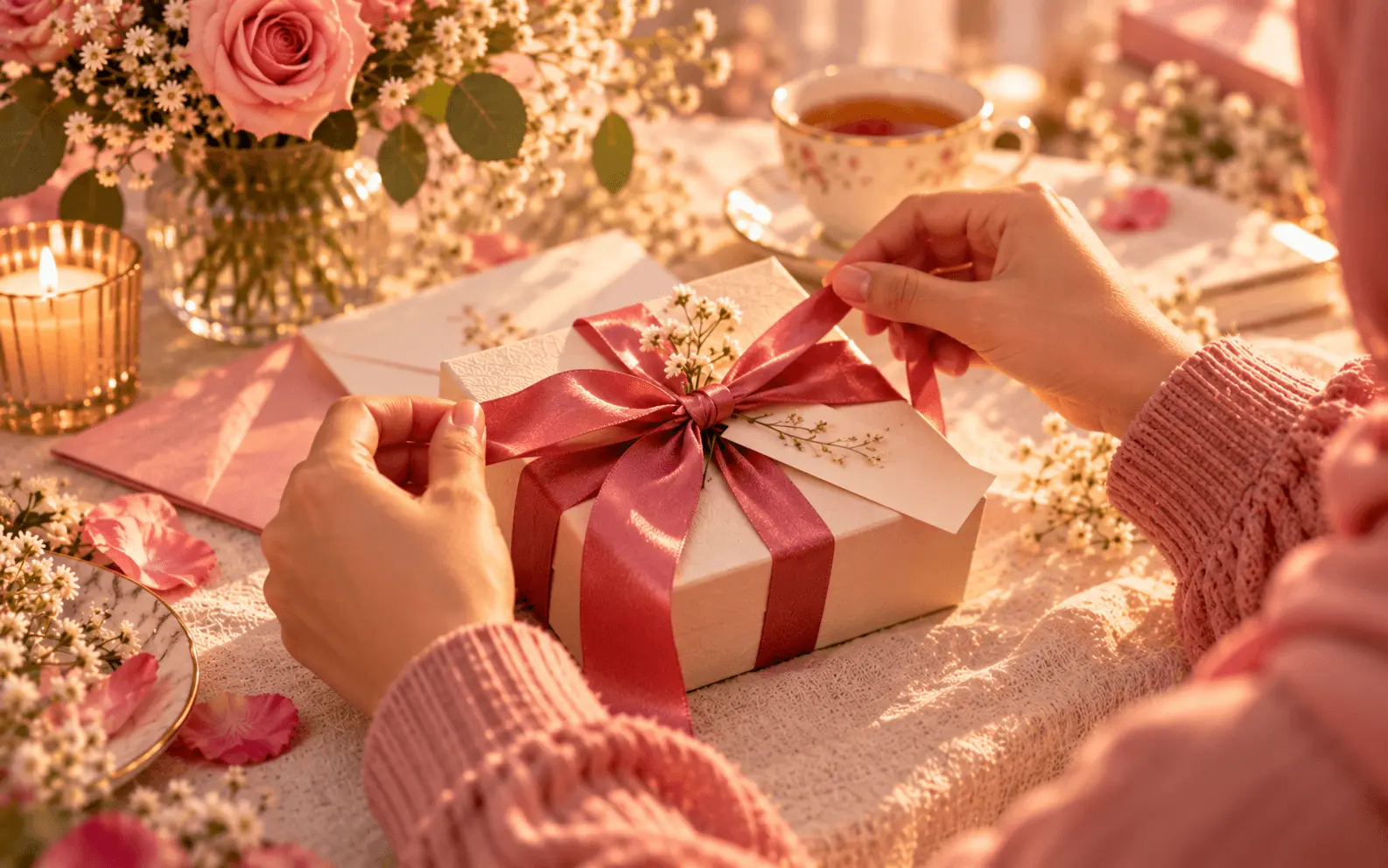
A gift is good partly because of the order things happen in. You see the paper, you feel the shape, you pull the ribbon, and only then do you see what is inside. A message can be written in the same order. It does not need tricks. It needs the most important line in the right place.
Here is how to write one, step by step, with examples you can adapt for any occasion.
The four parts of a message that opens like a gift
- The wrapping: a first line that sets the scene and gives nothing away.
- The ribbon: a line that builds a little, usually a memory or a reason.
- The gift: the line that is the point of the message.
- The card: a short close, often your name and a wish.
Four lines are enough. A message that opens like a gift is short, because each line has one job.
Step 1: write the wrapping
The first words often show up in the notification, before the message is opened. So the first line should make them want to read on without telling them everything.
- "I have been meaning to tell you something for a while."
- "Do you remember the first day we met?"
- "There is something I never said properly."
- "I made you something, and it took longer than I expected."
Avoid putting the main line here. "Happy birthday" as the first word is fine for a text. For a surprise, start one step earlier.
Step 2: tie the ribbon
The second line gives the reason or the memory that leads to the gift. It is where the message becomes about this person.
- "You were the only one who called every week the year I moved away."
- "Since that day, I have watched you get up every time things went wrong."
- "You never once made me feel like a guest in your home."
Step 3: give the gift
This is the line the message exists for. Say it plainly. After a build, simple words land harder than clever ones.
- "Thank you. I do not say it enough."
- "I am proud of you, and I wanted you to hear it."
- "I am sorry. You deserved better from me."
- "We are moving back home in June."
Step 4: close the card
One short line and your name. A wish, a plan, or nothing more than "with love". Do not add a second point after the gift: it pulls attention away from it.
Put together
A thank-you for a sister:
There is something I never said properly. The year I moved away, you were the only one who called every week, even when I had nothing to say. Thank you. It kept me going. Your little sister, Maya.
A birthday message for a friend:
Do you remember the first day we met? You lent me a pen and never got it back. Fifteen years later you are still the friend I call first. Happy birthday, Yusuf.
An apology to a husband:
I have been thinking about Sunday all week. You were trying to help, and I made you feel like you were in the way. I am sorry. Tea tonight, my turn to listen.
Mistakes that spoil the opening
- The reveal in the first line. The rest of the message has nothing left to do.
- Too much wrapping. Three lines of build before anything happens feels like a riddle.
- Two gifts. A thank-you and an apology and news in the same message compete with each other.
- A joke after the gift. It undercuts the line you built up to.
Let the message arrive like a gift too
The words can do all of this on their own. If you want the arrival to match, a surprise link adds the actual opening: the preview in the chat shows only their name, then they open something first (a gift box with a bow for a thank-you, a sealed invitation for a wedding, a message in a bottle for no reason at all) and your four lines appear.
For news you want to reveal, there are more examples in surprise reveal messages. For why the order matters, see the psychology behind openable surprises.
Write the wrapping, the ribbon, the gift and the card, then make it a surprise.